
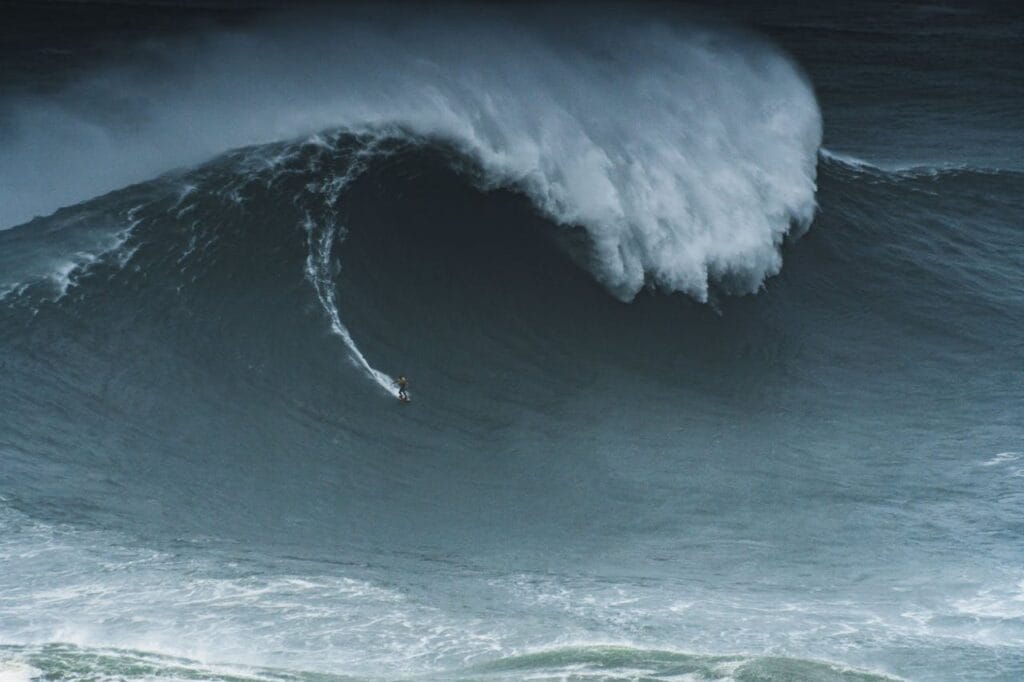
- Why Nazaré gets huge: The Nazaré Canyon channels Atlantic swell into Praia do Norte. On the shallow inner bar, energy stacks (shoaling) and two refracted wave trains can merge into a taller wedge.
- Best months to see giant waves: Nov–Feb (broader Oct–Mar).
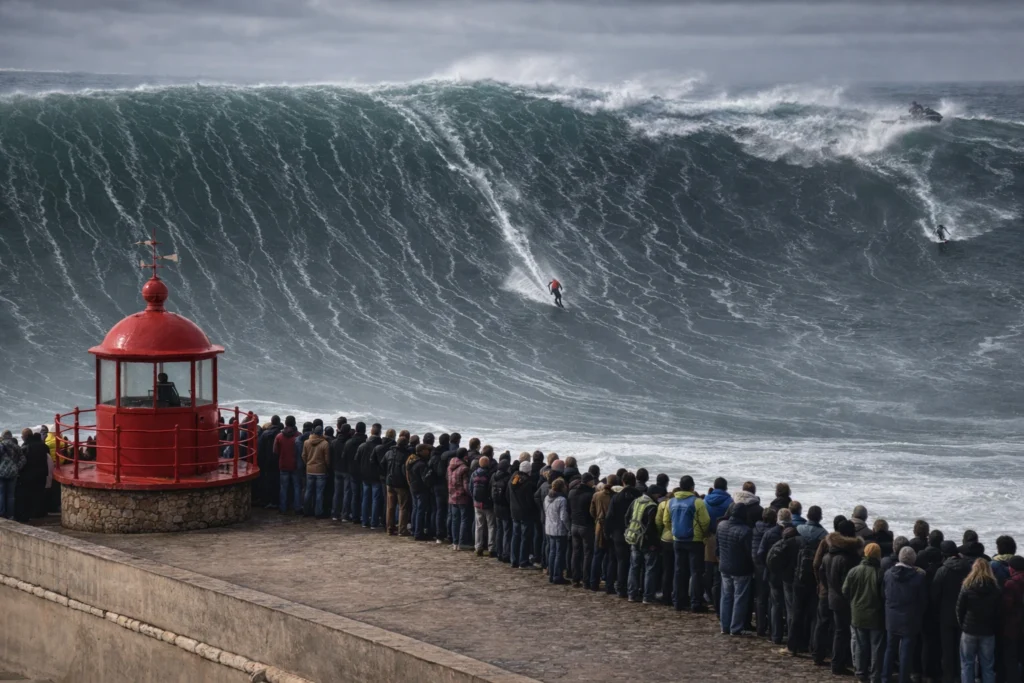
- Where to watch safely: Forte de São Miguel Arcanjo (lighthouse) terraces above Praia do Norte.
- Quick tools:
- Windy map (embedded below)
- IPMA significant wave height
- Praia do Norte webcams
This page is your quick‑action panel: use it to check whether today (or the next few days) looks like a proper big‑wave show before you drive up to the cliffs.
- At a Glance: Nazaré Big-Wave Forecast
- Today at Nazaré (quick links)
- Praia do Norte Interactive Forecast (Windy)
- How to Read the Forecast (2-Minute Guide)
- What Counts as a “Big-Wave Day” at Nazaré?
- Best Forecast & Info Sources
- Webcams: Watch Nazaré Waves Live
- Where to Watch Safely (and Smart)
- Getting to the Lighthouse on Big Days
- FAQ: Forecast & Viewing Tips
- Explore More Surf Spot Guides in Nazaré
- Related Nazaré Travel Guides
Some of the links on this website are affiliate links — if you book through them, we may earn a small commission (at no extra cost to you). This helps us keep the site running and create even more useful content for travelers like you.
If you’ve found our work helpful and wish to support us further, you can also make a small donation via PayPal. Every bit counts — thank you!
Spread the word about Nazaré’s big waves
Today at Nazaré (quick links)
Use this 30‑second routine to check if it’s worth driving up to Praia do Norte:
- Check significant wave height (Hs) and marine bulletins on IPMA.
- Use the Windy embed below: toggle Waves, Swell 1, and Wind layers; click offshore from the lighthouse to open the spot card (hourly Hs, period, direction).
- Open the Praia do Norte / lighthouse webcams to confirm face quality and wind texture.
- New here? See Where to watch safely ↓ before driving up on XXL days.
Tip: On big-swell mornings, re-check the webcam around sunrise—a small wind shift can make or break conditions.
- Flights: Find the Best Flight Deals to Lisbon
- Car Rental: Book Your Car Rental in Nazaré
- Hotels: Check Hotels & Stays in Nazaré
- Surf Camps: Find Your Ideal Surf Camp in Nazaré
- Activities: Book Fun Activities in Nazaré (boat tours, viewpoints)
- Tours: Discover Tours & Day Trips from Nazaré
Booking tip: November–February and holiday weekends fill up fast — lock in car + stays early if you’re aiming for a big‑swell window.
For full trip planning (how many days, routes from Lisbon/Porto, what to combine), use the dedicated Nazaré Surf Trip Guide on your site.
Praia do Norte Interactive Forecast (Windy)
Use the interactive Windy map embedded here to see:
- Offshore wave height (Hs) gradients into Praia do Norte
- Primary swell (Swell 1) direction and period
- Wind speed and direction above the headland
Pro move: On the spot card, switch between ECMWF / ICON / GFS to compare runs. ECMWF is often the most consistent for the west Iberian coast, but always cross-check when a swell is borderline.
How to Read the Forecast (2-Minute Guide)
1. Wave height (Hs) – Background Energy
Think of Hs as your background energy meter: higher Hs = more potential for big faces. Nazaré still needs the right period, direction and wind, but Hs tells you if the day is even worth considering.
- Rule of thumb: You want Hs clearly above the typical west‑coast baseline on the maps, with a strong height gradient feeding the headland.
2. Period (seconds) – Stored Power
More seconds = more stored energy and faster deep‑water travel.
- Starts to matter: ≥14 s
- Classic big‑wave days: 16–20 s is when the canyon usually “supercharges” incoming swell.
- Shortcut: 16–20 s + big Hs + good direction = real potential under the lighthouse.
3. Direction – Canyon Alignment
Direction decides whether the canyon gets “lit up” or not.
- Sweet spot: W–NW into the canyon axis.
- Too far N or WSW: The swell can miss the ideal focus onto Praia do Norte, even if numbers look good on paper.
4. Wind – Face Quality
Tide helps refine timing, but canyon focusing > tide here.
- Best grooming: NE–E (light–moderate) keeps faces clean and lines open for rescue teams.
- What to avoid: Strong onshore or cross‑onshore W–SW winds that crumble faces and add dangerous chop.
5. Tide – Helpful, but Secondary
Tide helps refine timing, but canyon focusing > tide here.
- Many big days look best on the push, yet period and direction are far more important than tide alone.
6. Model Reality Check
Forecasts are only as good as the models behind them.
- On the Windy spot card, compare ECMWF / ICON / GFS.
- If guidance diverges a lot, treat the day as uncertain and re‑check on the morning of the swell with updated runs and webcams.
One‑liners:
- Refraction = waves bend as depth changes.
- Shoaling = waves steepen and grow as water gets shallower.
For a full, plain‑English breakdown of the canyon and wave physics, your internal link goes to Nazaré Waves Explained: Why They Get So Big (Canyon + Best Time to See Them).
What Counts as a “Big-Wave Day” at Nazaré?
Use these rule‑of‑thumb thresholds as guides (never guarantees):
- Period: Ideally 16–20 s (≥14 s can still be impressive).
- Primary direction: W–NW into the canyon axis.
- Wind: NE–E or very light winds locally.
- Map signal: A clear height gradient aiming straight at the Sítio headland on Hs maps.
- Webcam confirm: A clean, steep face under the lighthouse with minimal cross‑chop and obvious scale.
Example of a classic big‑wave pattern:
- Hs 5–8 m on the west coast, period 16–19 s, swell WNW, light NE breeze at sunrise.
Set expectations:
Even with perfect numbers, local wind shifts, fog, rain and sandbar changes can flip the script. Always treat thresholds as filters, not promises, and confirm in real time on the webcams before committing to a long drive.
Best Forecast & Info Sources
- Windy – Interactive map with Waves, Swell 1, Wind, spot card and meteogram for Praia do Norte.
- IPMA – Significant wave height charts, coastal bulletins and marine warnings for Portugal.
- Instituto Hidrográfico – Background on the Nazaré Canyon and bathymetry (great context if you like the science).
- Webcam providers – Praia do Norte / lighthouse and town/main beach angles to sanity‑check conditions in real time.
- WSL event hub (in season) – For TUDOR Nazaré Big Wave Challenge status, green‑light calls and highlights.
Webcams: Watch Nazaré Waves Live
Before you drive to the lighthouse, check all three cams in this order. Use each for a different decision.
1. Praia do Norte (Lighthouse) — Decision cam
Shows the main peak and bowl under the fort. Use it to judge face quality, peak consistency, and overall scale.
5-second check: are sets standing up in the same place, with spray blowing straight back (offshore) and minimal cross-chop?
Nazare: Nazaré – Leiria, Portogallo: Canhao
2. Nazaré Canyon View — Set detection / wide angle
Wider shot that helps you spot long-period lines marching in and how the canyon line is feeding the headland. Great for seeing if bigger sets are lurking outside when Praia do Norte looks quiet.
Nazare: Nazarè praia do norte (LiveHD)
3. Praia da Vila (Town/Main Beach) — Wind & visibility sanity check
This angle is handy to confirm local wind, fog, rain, or sea-spray when the lighthouse lens is messy. If Town shows clean offshore while the lighthouse looks smeared, it’s likely spray on the lens, not bad wind.
Nazare: Nazaré – Leiria, Portogallo: Praia da Vila
How to read the cams (what “good” looks like)
- Defined sets marching in on a consistent peak (not breaking randomly along the bank).
- Clean faces with little to no cross-chop; lines look straight and groomed.
- Offshore tell: spray blown straight back from the lip (not sideways).
- Crowd & ops: tow/rescue craft staged and moving smoothly (often a sign the wind is cooperating).
Red flags (when to skip the mission)
- Webcam shows messy whitewater everywhere, sideways spray, or low cloud/fog sitting on the headland.
- Praia da Vila shows clear onshore while Windy suggested offshore → reality wins.
Troubleshooting (common webcam issues)
- Hazy / smeared view? Salt-spray on the lighthouse lens — refresh, try a different angle, or re-check in 10–15 min.
- Frozen frame? Browser cached the feed — hard refresh or open the “Open in new tab” links above.
- Night glare? Wait for first light; long-period swells are easier to judge at sunrise.
Where to Watch Safely (and Smart)
Watching is free; staying safe is non‑negotiable:
- Best vantage: Forte de São Miguel Arcanjo (lighthouse) terraces above Praia do Norte.
- Arrive early: On hyped swells, aim to be up there before ~10:00 — traffic control and temporary closures near the fort are common.
- Parking & walking: Park legally, expect to walk, and bring layers, water and sturdy shoes for wind and uneven ground.
- Respect barriers: Never cross fences or tape; give rescue teams plenty of space to operate.
- Photography tip: A telephoto lens (200mm+) and a soft cloth for salt spray make a huge difference on XXL days.
Want to understand the why behind the giant peaks? Read Nazaré Waves Explained (plain-English science, not a forecast page).
Getting to the Lighthouse on Big Days
- From Lisbon (LIS): Around 1 h 30 via A8 to Nazaré, then follow signs for Sítio / Farol / Forte.
- From Sítio da Nazaré: Follow the road toward the fort; on XXL days, expect slow traffic or restricted access, sometimes pedestrian‑only near the headland.
- Where to stay to avoid traffic headaches: If wave‑watching is your priority, stay in Sítio da Nazaré so you can walk to the terraces and skip parking stress.
For full directions to Nazaré by bus, train, car or transfer, use your dedicated Nazaré Surf Trip Guide.
Found this guide helpful? Share it with friends who’d love Nazaré too.
FAQ: Forecast & Viewing Tips
Related Nazaré Travel Guides
Things to Do Near Nazaré, Portugal – Top Activities
Already marveled at the legendary waves and cliffside views of Nazaré? If you’ve read our guides —…
Best Restaurants in Nazaré, Portugal
Looking for the best restaurants in Nazaré, Portugal? Whether you’re here for the big waves or the…
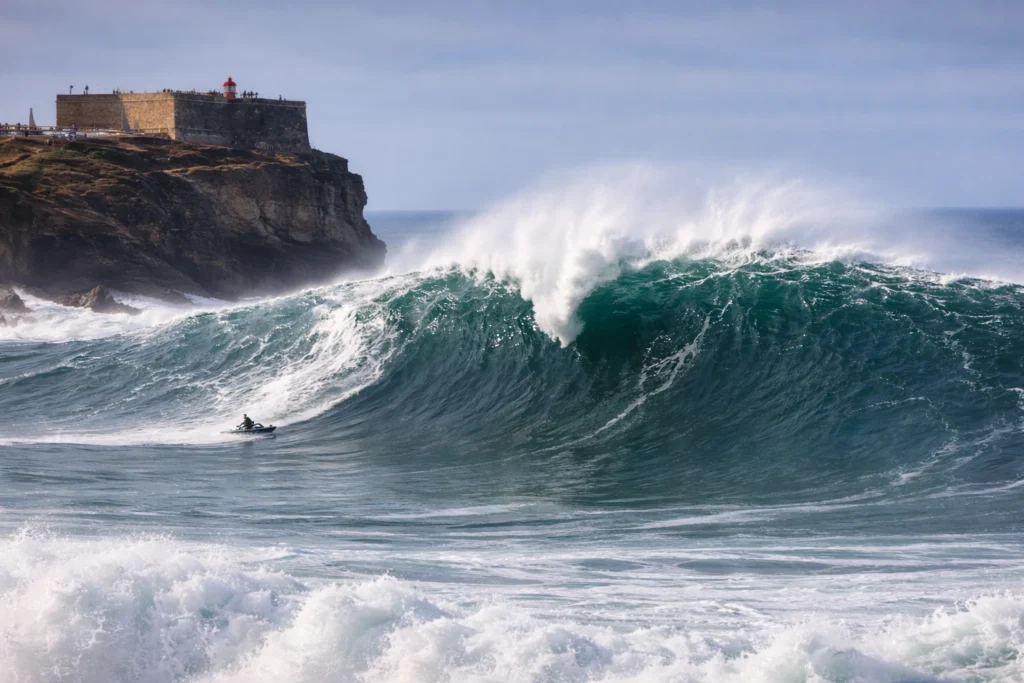
Nazare Big Wave Season (Month-by-Month): When to Go, What to Expect & How to Watch
The Nazaré big wave season runs October–March, with November–February the prime window—especially for long-period W–NW swells, NE–E…

Best Places to Visit Near Nazaré, Portugal
Already explored the captivating beaches, thrilling surf spots, and dramatic coastal cliffs of Nazaré itself? If you’ve…
Best Hotels in Nazaré, Portugal
Planning a trip to Nazaré, Portugal? Get ready for an incredible experience! Famous for its colossal waves,…

Is Nazaré, Portugal Worth Visiting?
Is Nazaré worth visiting? Absolutely! Nazaré, Portugal’s most famous fishing village, is a must-visit destination. It’s renowned…
Where to Watch Nazaré Big Waves: Best Viewpoints, Timing & Safety
If you’re wondering where to watch Nazaré big waves, the short answer is: from the Forte de…
Nazaré Waves Explained: Why They Get So Big (Canyon + Best Time to See Them)
Nazaré’s giant waves happen because a deep submarine canyon focuses powerful Atlantic swell straight toward Praia do Norte, then…